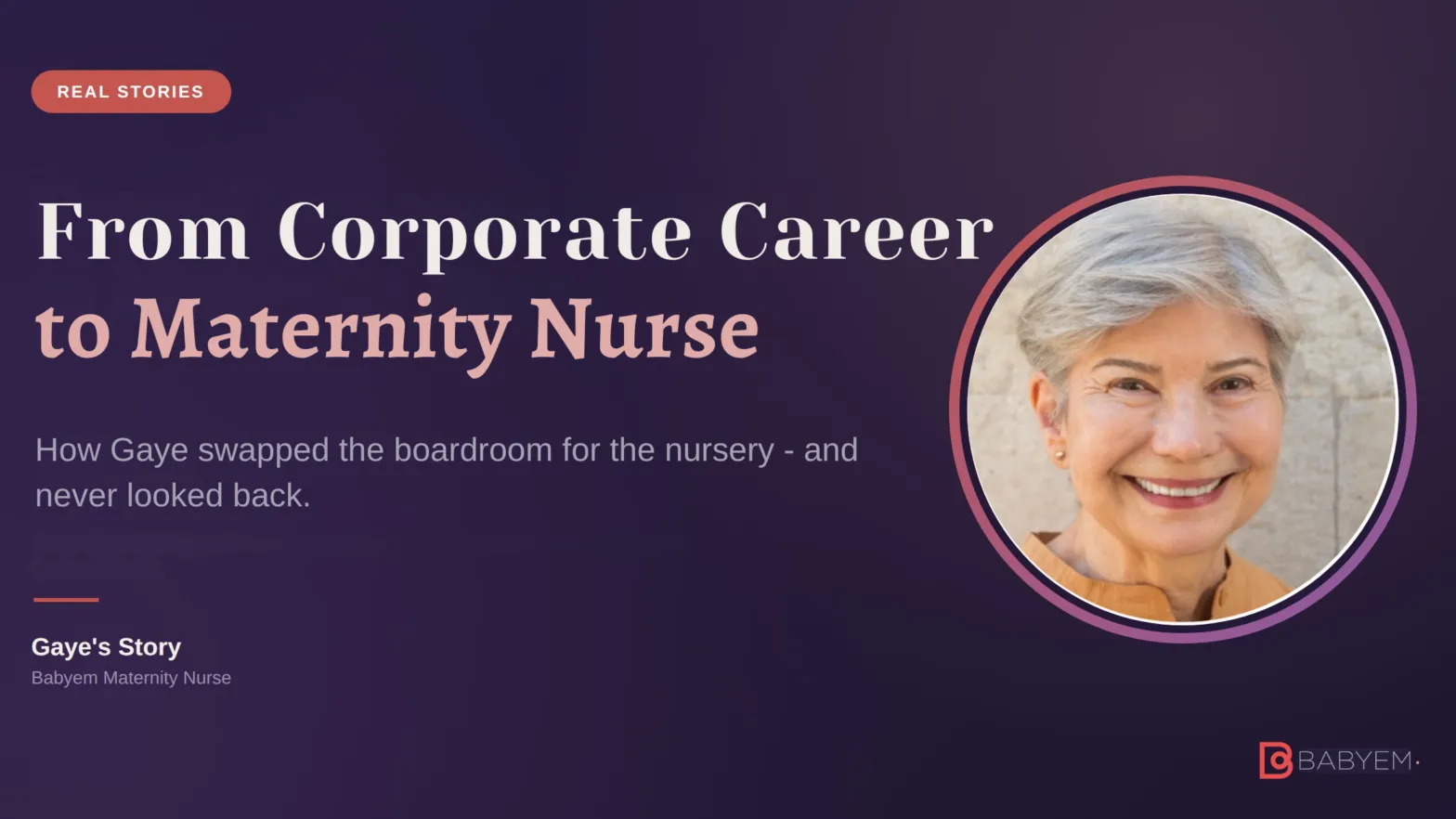
Quick answer: You do not need a childcare background to become a maternity nurse. Gaye left a career in corporate travel and conferences, had no professional baby experience, and built one of the most in-demand international maternity nursing practices over 12 years. This is her story and a practical guide for anyone considering the same transition. ‘From Corporate Career to Maternity Nurse. Gaye’s Story’. Watch the interview → Watch: Gaye’s full interview how she left the corporate world 12 years ago and built an international maternity nursing career from scratch. If you are at the earlier stage of exploring whether maternity nursing is right for you, start with our full guide: How to Become a Maternity Nurse in the UK. This blog focuses specifically on Gaye’s path, what it looked like in practice for someone with no professional childcare background, and what she would tell anyone considering the same transition. If you’re wondering whether someone like you could do this Most people considering maternity nursing as a career change have the same question underneath all the practical ones: is this actually realistic for someone with my background? The answer depends almost entirely on the wrong things people assume matter most. You do not need to be a nurse or midwife. You do not need to have worked in childcare for years. What Gaye’s story shows is that the qualities that make a great maternity nurse, empathy, patience, professionalism, the ability to read a room and hold your nerve at 3am, come from all kinds of backgrounds. Including corporate ones. Gaye spent most of her working life in international corporate roles, travel, conferences, events. She was good at it. She was also done with it. In 2009, watching the financial crisis reshape the industry she worked in, she made a decision that surprised people around her and defined the next decade of her life. The moment she decided to reinvent herself “I could see there were lots of changes and I thought. I need to reinvent myself again. I need to do something that’s good for me.”. Gaye Her sister is a nurse and midwife. She had always loved the idea of working with newborns. But retraining as a nurse felt impractical at that stage of her life. What did feel practical was starting smaller. She contacted an agency outside London and took a nannying role with a family who had a six-month-old. She stayed for a year.“I learned so much through the family,” she says. “I thought, yes, I really like this.” That first year was deliberate. She was not trying to become a maternity nurse overnight. She was building the foundation, learning what working inside a family home actually felt like, what babies and parents actually needed, and whether she had the temperament for it. The answer was yes. So she kept going. How she found maternity nursing, by accident The transition from nannying to maternity nursing happened in the way most good career pivots do: unexpectedly, through a specific job that changed everything. A family she was connected to had premature twins. They had a maternity nurse, but needed someone to cover her day off. Gaye stepped in. “That was my introduction to maternity nursing. And I thought this was the most wonderful job. I just built on that.”. Gaye She did the Level 3 maternity nurse course. Then a breastfeeding course. A postnatal depression course. She started taking the odd night here and there with families while still nannying, building experience and references without burning bridges or taking a financial risk she couldn’t afford. Then she approached a big London agency. She had roughly two years of experience at that point. Not a long CV by some standards. But she had references, she had specific newborn experience, and she had done the training. The agency gave her a chance. Her first three agency placements were all premature twins. “The easy jobs. I was thrown in at the deep end. But it was wonderful. It was an amazing experience.” Gaye What the role actually involves day to day Gaye works 24-hour placements, previously six days a week, now five, with longer breaks between bookings. She has worked in Barbados, Switzerland, South Africa, the US and across Europe. She is, as Emma says in the interview, extremely hard to get hold of because she is always booked. Her day typically starts between 6 and 7am, changing the baby, taking them to the mother for the first feed of the day, running through the night’s details. She keeps a diary for every family: feeds, sleep times, nappy changes, anything worth monitoring. She teaches as she goes. “I’m in the background ready to help. But I let the mother sort of I like to teach her and empower the mother.” Gaye She involves fathers. She recognises when a mother is overwhelmed and adjusts her approach accordingly. She knows when a baby’s feeding difficulty might indicate something medical and knows when to say “I think we should get this checked by a paediatrician” rather than guessing. She explains sleep biology to parents, awake windows, circadian rhythm, developmental norms , in conversation, not in lectures. She also has a filter she applies before every booking now, built from early experience of getting it wrong. “I went into one or two families and I thought maybe I can change them. And then I thought, no. Now I’m a lot more discerning. I make sure that the family’s values are aligned with my values, because I have a very gentle approach..” Gaye She tells every prospective family from the first WhatsApp message: this is my approach. If they want a baby sleeping through the night in two weeks, she is not the right fit. That clarity, she says, makes every placement work better. Why her corporate background turned out to be an advantage This surprises people, but it shouldn’t. A career in international corporate work builds skills that are directly transferable to high-end private… Continue reading From Corporate Career to Maternity Nurse: Gaye’s Story


Category: Student Stories
The Power Of Touch: Improving Connection With Baby Massage With Sejal Fichadia

“skin is the brain – on the outside!” – Sejal Fechadia
Not tongue tied anymore – Mags Kirk’s mission to help as many families as she can

“It’s not just enough to have a look – you can’t diagnose a tongue tie just from looking. You have to assess how the tongue’s movement impacts feeding.” – Mags Kirk
The journey to becoming fully booked as a Sleep Coach in only 9 months (with Claire Maguire)
I can use every second I’m with a client-focused on helping them, knowing that there is something automatic in the background running the business.
60 Seconds (or close!) with IBCLC, Mindful Breastfeeding Practitioner & Holistic Sleep Coach Sian Aldis – owner of the agency No Milk Like Mama’s

What’s the most common myth about breastfeeding?
A lot of parents believe that breastfeeding is painful. But actually breastfeeding shouldn’t be painful.
60 second interview with Lesley Pournara
We caught up with Lesley Pournara who recently completed the Babyem Maternity Nurse Training.
60 Second Interview with Loraine Williams

I get fulfillment from seeing the attachment between mum and baby, knowing that I have helped create that.
60 Seconds with Holly Austin

I came across Babyem’s Postnatal Maternity Training course and decided to take the leap. I wanted a course that would teach me as much as possible about ranging from newborn sleep to colic and reflux, from a credible evidence-based point of view!
Interview with…Doris Nginis, Maternity Nurse

Can baby massage techniques help with colic?
Interview with…Rhadi Mattarozzi, Maternity Nurse
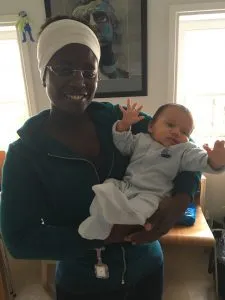
The similarity between working in a Neonatal Department and working in the private sector as Maternity Nurse is in the fact that you perform nursery duties, looking after newborns and you teach and support mums with the breastfeeding and both parents with taking care of their little ones.
Notifications