

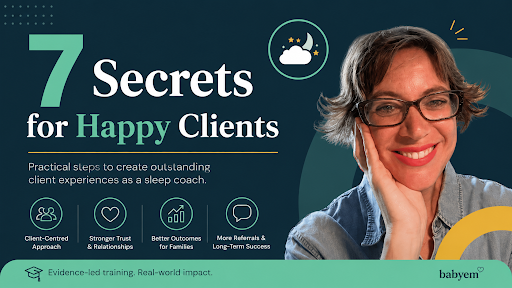
 The most successful sleep consultants do more than improve infant sleep. They create a professional experience that helps families feel supported, informed and confident throughout the process. Positive client outcomes are built on clear communication, realistic expectations, evidence-informed practice and strong professional relationships.
Why Client Experience Matters in Sleep Coaching
When practitioners first enter the world of infant sleep support, many assume success is measured solely by sleep outcomes.
In reality, families often remember something much deeper.
- They remember how they were treated.
- They remember whether they felt listened to when they were exhausted, overwhelmed or uncertain.
- They remember whether the support felt personalised, safe and respectful.
At Babyem, we teach practitioners that sleep support is never just about sleep. It exists within a wider picture that includes infant development, feeding, temperament, parental wellbeing, family values and professional boundaries.
That is why exceptional client experiences rarely happen by accident. They are built intentionally.
Here are seven principles that consistently help sleep consultants create better outcomes for families and stronger professional reputations.
1. Work With Families You Are Best Placed to Support
Not every family will be the right fit for your approach, and recognising this is an important part of professional practice.
Families arrive with different expectations, parenting philosophies and support needs. Some may be looking for guidance that aligns with your values and expertise. Others may require a different level of support or a different practitioner entirely.
Successful sleep consultants communicate their approach clearly through their website, consultation process and client materials.
This helps families make informed decisions while reducing misunderstandings later in the relationship.
Professional confidence includes knowing when to say yes and knowing when a referral may be more appropriate.
2. Match the Support Package to the Family's Needs
One of the most common causes of client dissatisfaction is a mismatch between expectations and support levels.
A family facing multiple challenges involving sleep, feeding and parental wellbeing may need ongoing support rather than a single consultation.
Before beginning work, take time to understand:
- The complexity of the situation
- The family's goals
- Previous attempts to improve sleep
- The level of support required
The right package protects both the practitioner and the family while creating a stronger foundation for success.
3. Create a Professional Experience Before the First Consultation
Client confidence begins long before the consultation itself.
Every interaction contributes to the family's perception of your professionalism.
This includes:
- Your website
- Booking systems
- Welcome emails
- Intake forms
- Educational materials
Families often seek support during periods of significant stress and sleep deprivation. Clear communication and straightforward processes help reduce anxiety and build trust from the outset.
Simple systems create a smoother experience for everyone involved.
4. Set Realistic Expectations From Day One
Families deserve honest conversations about what change may realistically look like.
One of the fastest ways to damage trust is allowing unrealistic expectations to develop.
Effective expectation setting includes discussing:
- Likely timelines
- Factors influencing progress
- The family's role in implementation
- Potential setbacks
- What success may realistically look like
Sleep support is rarely a linear process.
When practitioners communicate this openly, families are often more resilient when challenges arise.
5. Use a Coaching Approach Rather Than a Directive Approach
Many parents seeking sleep support are carrying exhaustion, frustration, self-doubt or guilt.
In these situations, simply providing instructions is rarely enough.
Effective practitioners combine knowledge with coaching skills.
This means:
- Listening actively
- Validating concerns
- Understanding family priorities
- Encouraging collaborative decision-making
- Supporting confidence building
When families feel heard and respected, they are more likely to engage with the process and sustain positive changes over time.
At Babyem, we teach practitioners how to move beyond scripts and develop the communication skills needed for real-world family support.
6. Stay Curious and Consider the Whole Family Context
Infant sleep does not exist in isolation.
Sleep challenges may intersect with:
- Feeding difficulties
- Developmental changes
- Temperament
- Medical concerns
- Family stress
- Parental mental health
- Environmental factors
The strongest practitioners resist the temptation to jump straight to solutions.
Instead, they gather information, ask thoughtful questions and explore the wider context before making recommendations.
This holistic approach often leads to safer, more appropriate and more sustainable outcomes.
7. Build Strong Follow-Up and Professional Closure
The client experience does not end when a sleep plan is delivered.
Follow-up support helps families feel guided during implementation and creates opportunities to address questions as they arise.
Equally important is professional offboarding.
Families should always know:
- When support ends
- What future support options exist
- How to access additional resources
- When to seek further professional help
A thoughtful ending reinforces trust and often becomes the reason families recommend a practitioner to others.
What Families Remember Most
After training more than 20,000 practitioners ( In Babyem) across 42 countries, one lesson continues to emerge.
Families rarely talk about a particular sleep strategy.
They talk about how supported they felt.
They remember whether their practitioner listened.
They remember whether they felt judged.
They remember whether the support respected their family values.
Technical knowledge matters. But trust, communication and professional judgement are often what transform a good consultation into an exceptional client experience.
For practitioners, long-term success comes not from delivering identical solutions repeatedly, but from developing the confidence to support each family as an individual.
Frequently Asked Questions
What is the most important factor in client satisfaction for sleep consultants?
Clear communication is one of the strongest predictors of client satisfaction. Families are more likely to feel positive about the experience when expectations, boundaries and support processes are explained clearly from the beginning.
Why is a coaching approach important in infant sleep support?
A coaching approach encourages collaboration, confidence and informed decision-making. It helps families feel empowered rather than dependent on the practitioner.
How can sleep consultants avoid professional burnout?
Strong boundaries, clear support structures, appropriate package design and effective client communication all help reduce practitioner overwhelm.
Why is holistic sleep support important?
Sleep is influenced by many interconnected factors including feeding, development, temperament and parental wellbeing. Considering the whole picture helps practitioners provide more effective and responsible support.
What makes Babyem's approach different?
Babyem trains practitioners to think critically, work safely and support families confidently in real-world situations. Rather than relying on rigid scripts, practitioners learn to integrate evidence, professional judgement and holistic family-centred care.
Ready to Develop Your Professional Practice?
Babyem's Advanced Holistic Sleep Coaching Programme helps practitioners build the knowledge, judgement and confidence needed to support families responsibly and effectively.
Explore our professional training programmes and discover why more than 20,000 practitioners across 42 countries have chosen Babyem to support their professional development.