
Maternity Nurse Training
London
Taught in person by Shel Banks IBCLC · South Kensington, London
OCN Level 3 & 4, independently regulated. Two days of in-person training in London combined with online learning, for practitioners who want to support newborn families with genuine depth and confidence.
- OCN Accredited Level 3 & 4
- Max 18 per cohort
- Agency recognised
- Lifetime access
- Next London course
- 24–25 Oct 2026September fully booked · See October dates →
- Investment
- From £485or from £135 a month
- In person
- 2 daysThe Strathmore Hotel, SW7
- Online modules
- Self-pacedLifetime access
Step 1 of 2 — you'll choose your weekend and confirm your details, then pay on the next screen to secure your place.
★★★★★ 4.9 from 130+ Google reviewsRecommended by




Three things that set this training apart
Taught by someone who shaped the evidence
Shel Banks is an IBCLC Lactation Consultant who has contributed to Cochrane reviews, written national clinical guidelines for NICE, and shaped policy for Bliss. You are not learning from a trainer. You are learning from someone who helped write what practitioners are trained on.
- IBCLC
- Cochrane contributor
- NICE guidelines
- Bliss policy
- Published author
Practical experience with families after you qualify
Eligible England-based graduates can apply for Babyem's optional newborn placement pathway — real experience with real families, after you qualify. Full details below →
Training that keeps going after you qualify
After you qualify you'll continue to have access to quarterly CPD workshops and expert Q&A, a lifetime private practitioner community, the masterclass vault (multiples, tongue-tie, birth trauma and more) and placement pathway eligibility. Most training ends when you close your laptop. This one is built for the long term.
- Quarterly CPD included
- Lifetime community
- Masterclass vault
- Placement scheme access
Four steps. One clear path
- Before London
Online pre-learning
Around 6 hours of structured modules, at your own pace, before the London weekend.
Self-paced · Lifetime access - London weekend
Two days in person
Saturday and Sunday, 9.30am–5pm, at The Strathmore Hotel, South Kensington. Taught by Shel Banks. Max 18 per cohort.
In person · London · Max 18 - Post-course
Written assessment
An essay-based assessment submitted at home within 7 weeks, at Level 3 or Level 4. Tutor support throughout.
7 weeks · Tutor supported - Accreditation
OCN certificate issued
You get a Babyem completion certificate on the day. Your work is then marked and externally verified, and your OCN London certificate arrives around four weeks after the final assessment process.
OCN accredited · Agency recognised
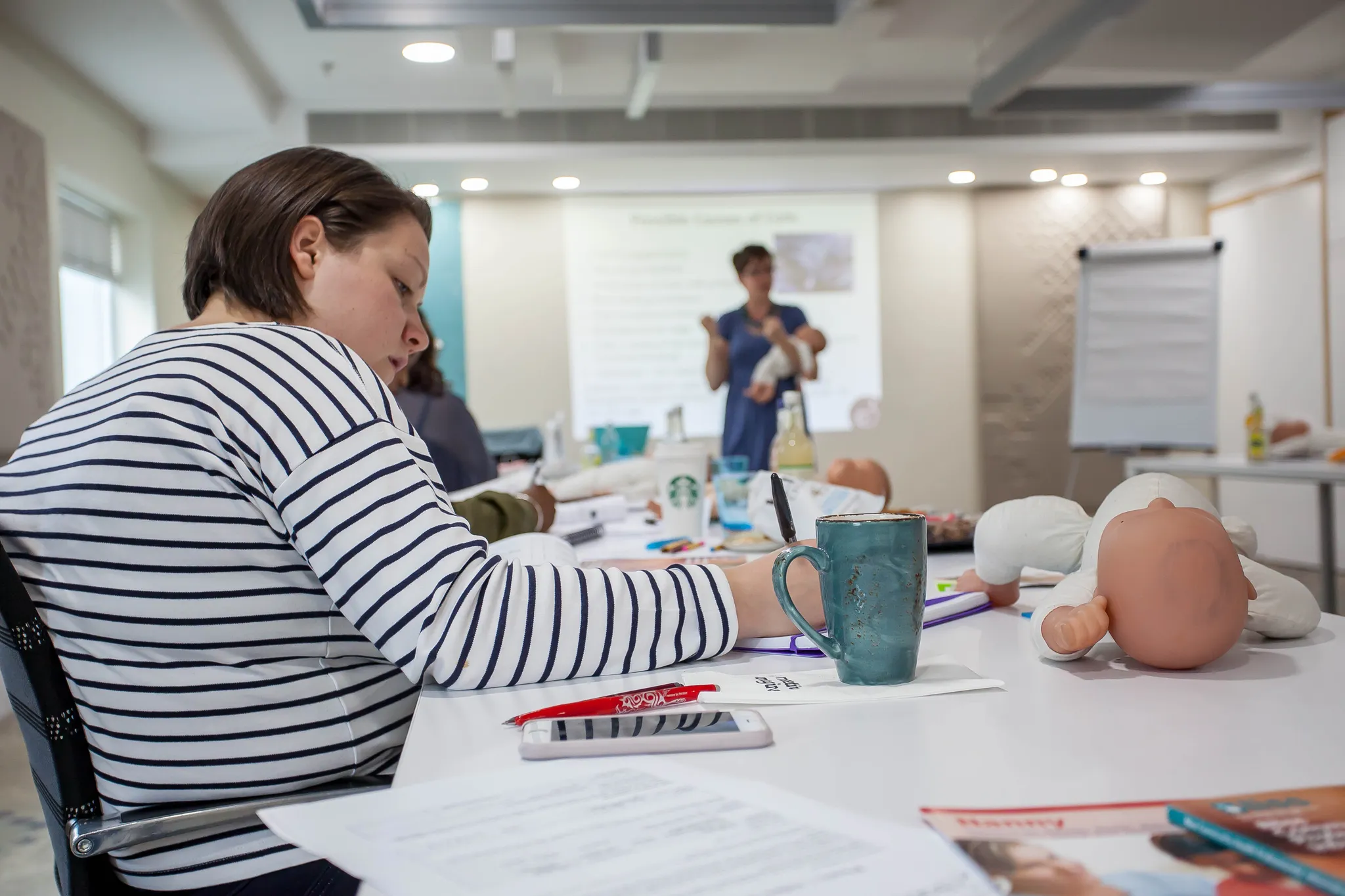
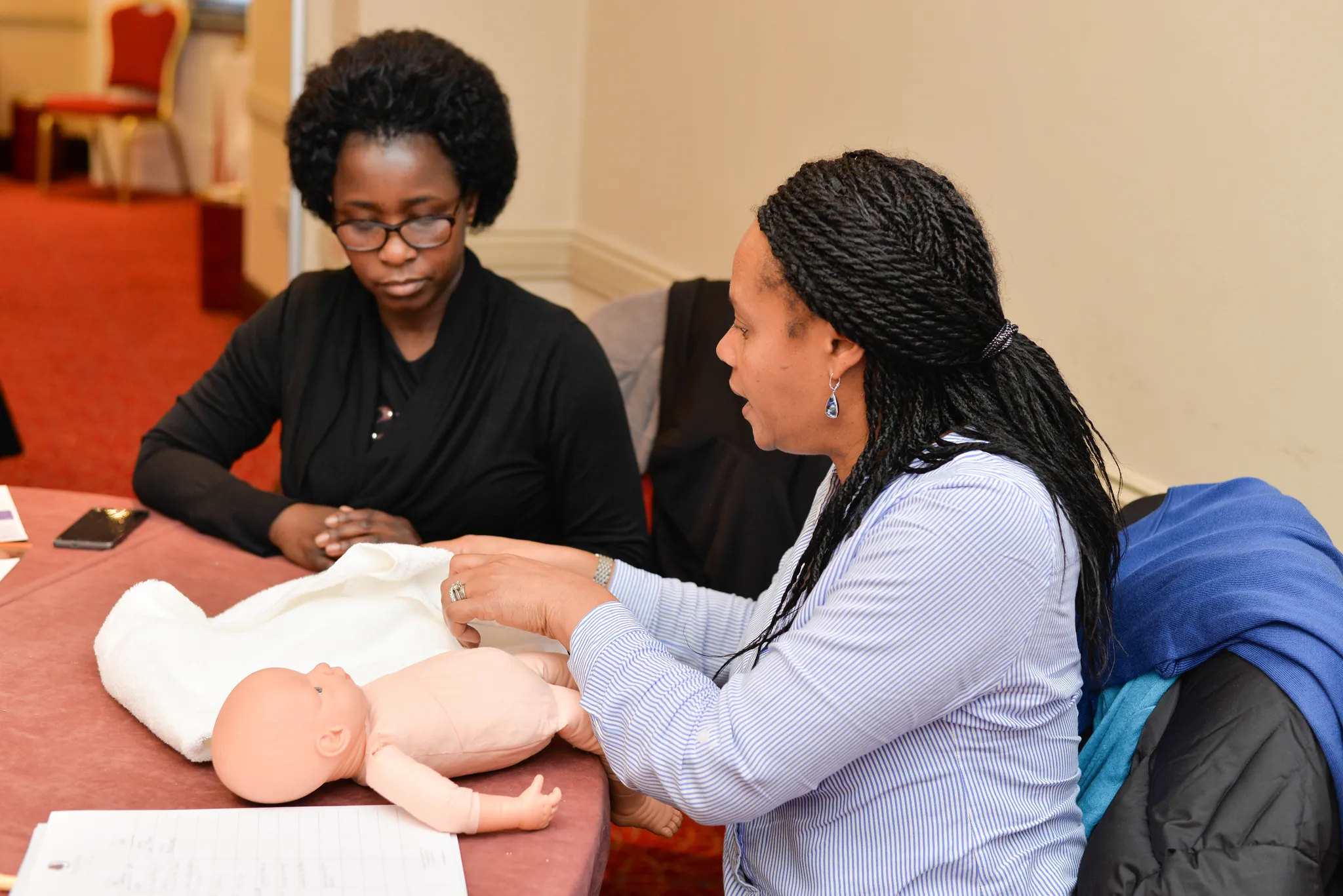
See what two days in London looks like
A small cohort. A clinical expert at the front of the room. Evidence-based teaching that goes well beyond a manual, and a room full of practitioners who take their work seriously.


Choose your London training weekend
Families in the early days need to feel held, heard and confident in themselves
The families you'll support are at one of the most tender, overwhelming and significant moments of their lives. They're not looking for someone to take over, they're looking for someone who helps them trust themselves.
That takes real knowledge, of babies and of people. Evidence-based practice. Calm authority. Knowing when to step in and when to step back.
"We don't just tell you what to do. We tell you why, based on evidence, and how to apply it to the individual in front of you."
Whatever your background, this is where you go deeper
A minimum of one year's hands-on experience with babies is recommended. Practitioners from clinical and childcare backgrounds are equally welcome.
Six modules. Everything a world-class maternity nurse needs.
All students are taught to OCN Level 4 standard. The online platform includes structured lessons, quizzes and resources you keep for life.
- L3 & L4
- OCN accreditation
- 2 days
- London in-person
- 7 weeks
- To complete assessment
- Lifetime
- Access to online content
01Working as a Maternity Nurse
This is where you stop being someone who looks after babies and become the professional families trust with their most precious thing, with the judgment, the boundaries, the business foundations and the reputation to match.
- The reality of the role, scope, responsibility and professional judgment in the home
- Ways of working: live-in, daily, NICU support, sole charge and beyond
- Boundaries in practice, knowing when to act, when to refer, when to step back
- Observation, awareness and professional decision-making in real family settings
- Working safely and professionally within a family home
- Communication skills for supporting exhausted or distressed parents, empathy, open questions and professional boundaries, taught throughout the programme
- Business & legal foundations, contracts, insurance, self-employment, rates, tax
- Professional visibility and networking, building a reputation that fills your diary
02Sleep Science & Infant Sleep
Gentle, responsive and grounded in developmental science, including the neuroscience of infant brain development, stress regulation and early emotional safety. You'll understand infant sleep at a biological level, which means you can support families with real confidence, not guesswork.
- How infant sleep cycles work and why they differ so fundamentally from adult sleep
- Infant brain development, synapse formation, the limbic brain and the neuroscience of regulation
- Why babies wake frequently, and why that's normal, not a problem to fix
- Newborn sleep patterns, awake windows and the huge range of what's developmentally typical
- Helping families develop realistic expectations, because normal infant sleep is widely misunderstood
- The fourth trimester, why babies are neurologically immature at birth and what they need to feel safe
- Co-regulation vs self-regulation: why babies cannot calm themselves alone, and the caregiver's role
- Stress regulation in infancy, cortisol, oxytocin and the science behind responsive caregiving
- Practical, responsive settling strategies: swaddling, white noise, rocking, babywearing, cluster feeding and more
- Safe sleep, SIDS prevention and bed-sharing guidance, current evidence and how to advise families with confidence
03Baby Care & Development
From the first bath to the first steps, the clinical care skills and developmental knowledge that underpin everything you do in a family home.
- Newborn skin, jaundice, cord care and the first days of life
- Bathing, holding, handling and practical newborn care
- Attachment and emotional regulation, why it matters and how to support it
- Reflexes and motor development: what you should see, and what warrants a flag
- Communication and language foundations in the first year
- Cognitive development and play, how to support a baby's growing brain
- Child development milestones 0–12 months, and how to use them in practice
04Feeding: Breast, Bottle & Beyond
Breastfeeding. Formula. Expressing. Paced feeding. Tongue-tie. The clinical depth to know what's happening, and the professional scope to know your limits.
- Infant feeding cues, winding and responsive feeding, the foundations done properly
- Breastfeeding: positioning, attachment, milk supply, routines and troubleshooting
- Breastfeeding difficulties: cracked nipples, engorgement, mastitis, thrush, clinical knowledge with practical support strategies
- Expressing: when, why, how, methods and the emotional context for parents
- Formula feeding: types, safe preparation, sterilisation, storage and the emotional sensitivity required
- Responsive bottle feeding, paced, baby-led and how to support parents in practice
- Supplementing and mixed feeding, navigating this with families confidently
- Tongue-tie: what it is, how it affects feeding (breast and bottle), what to observe, and how to refer appropriately, without overstepping
- Pumping & expressing: professional awareness, recognising distress and responding within scope
Further reading from BabyemTongue-tie explained · Signs a baby is breastfeeding well · Perceived low milk supply
05Colic, Reflux & the Crying Baby
The hardest nights families face, and the knowledge that makes you indispensable when they happen. Clinical depth, evidence-based practice and the judgment to know when to escalate.
- Infantile colic, definition, prevalence, evidence on contributors and what actually helps
- What colic is and is not, cutting through the noise for parents and professionals alike
- Reflux: the spectrum from normal GOR to GORD, silent reflux and serious differentials
- Physiological reflux vs pathological reflux, knowing the difference clinically
- Treatment for reflux and when to refer to a specialist
- Supporting families through relentless crying, professional practice and emotional impact
- Cow's milk protein allergy, lactose intolerance and the role of the maternity nurse
- When to escalate, when to refer, when to reassure
Further reading from Babyem20 myths about colic · A quick look at reflux
06Illness Recognition, Clinical Safety & Maternal Recovery
You are often the most qualified person in the room, for the baby and for the mother. This module gives you the clinical knowledge to spot what matters, act with confidence and support the whole family.
- Fevers and temperature management in newborns, what's normal, what's not, what to do
- Common infections: ear, throat, urinary, respiratory and digestive
- Contagious childhood illnesses, recognition, management and parental guidance
- Meningitis, signs, symptoms and emergency response
- Sickle cell disease awareness in newborn care
- Premature, low birth weight and sick babies, corrected age, post-discharge concerns, feeding and development
- When to seek urgent help, clinical red flags and how to communicate them confidently
- Postnatal maternal recovery, physical healing after vaginal birth and caesarean section, bleeding, pelvic floor, diet and rest
- Postnatal mood disorders, baby blues, PND and birth-related PTSD: recognition, support and when to refer
Further reading from BabyemA brief guide to birth trauma & PTSD
L4Level 4 only — 3 additional modulesL4
Three additional modules that take your knowledge into territory most maternity nurses, and many healthcare professionals, never reach.
Culture, Birth & Postnatal Recovery
- Islamic, Jewish, African, Chinese, Korean and Eastern European postnatal traditions
- LGBTQ+ families, feeding, recovery and inclusive postnatal care
- Supporting feeding, sleep and recovery across different cultural contexts
- Postnatal mother care: physical recovery, PND, bleeding, diet and practical support
Baby Temperament & Advanced Development
- Temperament types, orchids, dandelions and high-need babies
- How temperament shapes feeding, settling and parental experience
- Developmental milestones and leaps 0–3 months in clinical depth
- Understanding and supporting developmental changes as they happen
Flat Head Syndrome & the Osteopathic Perspective
- Synostotic vs non-synostotic plagiocephaly, clinical distinction, not just labels
- The osteopathic perspective on infant head shape and sleep positioning
- Treatment pathways, referral criteria and how to guide families confidently
Further reading from BabyemBabyem's guide to osteopathy
Clinical expertise you cannot get anywhere else

Lead Trainer & Director
Shel Banks
Shel Banks is an IBCLC Lactation Consultant with two decades of clinical practice working directly with newborns and families. She has contributed to Cochrane systematic reviews, written national clinical guidelines for NICE, and shaped policy for Bliss, the UK's leading premature baby charity.
She leads every London blended training day in person. The situations and families she teaches from are the same ones you will encounter the moment you graduate.
- IBCLC
- Cochrane contributor
- NICE guidelines
- Bliss policy
- Published author
Most trainers teach from a manual. Shel helped write what the manuals are based on.
What you will be equipped to do
Support newborns and families with genuine confidence
Feeding, sleep, colic, reflux, allergies, development, across the areas families need most, grounded in current evidence.
Read the situation, not just follow a script
Understand the why behind every recommendation. Apply evidence responsively to the individual family, not as a formula.
Know when to support and when to refer
Recognise the limits of your role. Hold your knowledge with confidence, and connect families with the right support when needed.
This accreditation opens doors in several directions
Graduates come from different backgrounds and go on to practise in different ways. Here are the most common.
Maternity Nurse (Newborn Care Specialist)
The core career this training leads to. You support families at home in the first weeks after birth — feeding, sleep, settling and newborn care. Work through agencies, privately or internationally.
Nanny with Newborn Specialism
Already working as a nanny? This credential adds specialist newborn expertise that agencies actively look for, and justifies higher rates.
Night Nanny
Overnight support only — night feeds, settling and gentle sleep routines. Flexible hours, well suited to practitioners who prefer to work evenings and nights.
Postnatal Support Practitioner
Daytime practical and emotional support. A growing role, particularly for practitioners with doula, health visiting or nursery nursing backgrounds.
Practical experience with families after you qualify
Eligible England-based graduates can apply for Babyem's optional placement pathway after completing the course. Graduates browse family listings themselves and families contact them directly from the board, with Babyem completing the checks required to take part.
The pathway may include families referred through our work with organisations such as NCT, Twins Trust and other family support organisations, where suitable opportunities are available.
The Placement Scheme is optional and available to England-based graduates only. Placements are unpaid; families cover travel and food expenses. Placement opportunities are not guaranteed and depend on family availability, location, graduate suitability and Babyem's approval process. Babyem does not guarantee paid work, employment or agency representation after completion.
85%
of graduates who participated in the Placement Scheme said it directly helped them gain paid work as a maternity nurse.
Based on 75 respondents.
Trusted by the agencies who place the best practitioners
"We are continuously impressed by their level of maternity and nanny training."
"Those with a background in childcare wishing to train as a maternity nurse should enrol."
"We are really impressed with the content, the teaching style and the flow of the day."
"Our nanny candidates have consistently given us great feedback about Babyem."
Real outcomes from real practitioners
★★★★★ 4.9 / 5 from 130+ verified Google reviews
Although I worked as a nanny for 16 years, I wouldn't be a Maternity Nurse without this course, its placements, and ongoing support.
 Rabia DoucoureMaternity Nurse
What won me over with Babyem is how attentive they are. The course exceeded my expectations and explored all possible topics that I could imagine, all of which was based on scientific research.
 Anna Chrysa RutterNanny & Montessori Teacher
I got offered a job after just one day on Babyem's Maternity Placement Scheme, working with twins which were 6-weeks premature.
 Darcey DavidMaternity Nurse
How enrolment works
It takes two steps, and both happen in one sitting.
- Register and choose your weekendYou'll pick your London date and confirm your details, including your date of birth for OCN registration, your postal address and agreement to our cancellation and refund policy.
- Pay to secure your placePayment details are taken on the next screen. Registering does not hold your place on its own — it's only secured once payment is made, so have your card to hand.
Choose your level. Start your training
All students are taught together in the same room, to the same Level 4 standard. You choose your accreditation level when you enrol, and you can upgrade from Level 3 to Level 4 later by paying only the difference.
For context, maternity nurses in the UK commonly charge in the region of £180–£250 a day. At Level 3, the training costs less than three days' typical work. Rates vary with experience, location and the type of booking, and Babyem cannot guarantee earnings or employment.
OCN Level 3
£485
Pay in full · or from £135 a monthPayment plans: 3 × £168 · 4 × £135
- All content taught to Level 4 standard
- 2 days in-person training, London
- Full online learning modules
- Lifetime access to online content
- Private practitioner community, lifetime
- Masterclass vault access
- Quarterly CPD workshops & expert Q&A
- Newborn Placement Scheme (England · optional)
- OCN Level 3 accreditation
Best for: practitioners entering the field or refreshing their knowledge — full accreditation with complete practical and community access.
Register at Level 3OCN Level 4
£650
Pay in full · or from £168 a monthPayment plans: 3 × £223 · 4 × £168
- Everything included at Level 3, plus:
- 3 advanced Level 4 modules — Culture, Birth & Postnatal Recovery · Baby Temperament & Advanced Development · Flat Head Syndrome
- Higher-level critical analysis and written coursework
- OCN Level 4 accreditation
Best for: practitioners who want the highest level of formal accreditation, with three advanced modules at foundation degree standard.
Register at Level 414-day money-back guarantee · Full refund within 14 days of enrolment, provided the written assessment has not been submitted. Upgrade from Level 3 to Level 4 at any time, paying only the difference. A small administration fee applies to payment plans, so paying in full is the lowest total cost.
Not sure which level is right for you? Contact us — we're happy to help you decide.
Answered honestly
Before you book
Do I need previous experience with babies?
We recommend having at least one year's experience caring for babies before attending the Maternity Nurse Training.
You might already be working as a nanny, nursery practitioner, doula or in another role supporting babies and families. The training is designed to build on that experience and develop your specialist knowledge and confidence in newborn care.
If you're unsure whether your current experience is suitable, please get in touch with our team before booking.
Is this course suitable if I'm already a nanny?
Absolutely. In fact, maternity nurse training can be a natural next step for experienced nannies who particularly enjoy working with newborns and younger babies.
Some nannies complete the training to deepen their newborn knowledge while continuing in their existing role. Others begin taking on newborn or maternity work alongside nannying, while some choose to transition gradually into maternity nursing.
The roles can also offer a different way of working. Nannies are commonly employed by one family, whereas maternity nurses typically work on a self-employed basis for families for defined periods of time.
For many experienced childcare professionals, this can offer greater flexibility and the opportunity to specialise in the stage of family life they are most passionate about.
Can I pay in instalments?
Yes. Level 3 can be paid as 3 × £168 or 4 × £135. Level 4 can be paid as 3 × £223 or 4 × £168.
A small administration fee applies to payment plans, so paying in full is always the lowest total cost.
Should I do the London weekend or train fully online?
Both routes are OCN accredited to the same levels, taught to the same standard, assessed the same way, and lead to the same certificate. Eligible England-based graduates get the same access to the optional Newborn Placement Scheme, quarterly CPD, the practitioner community and the masterclass vault whichever route they take.
The difference is the two days in the room. In London you learn with Shel Banks in a cohort of no more than 18, take part in the practical, hands-on sessions that can't be done on a screen, and ask your questions live. The fully online route starts immediately with no fixed dates and is taught by the wider Babyem specialist team, which suits practitioners with unpredictable hours or anyone outside the UK.
Choose London if you learn best with people in the room and can commit to a set weekend. Choose online if you can't. Compare both routes side by side →
What approach to newborn care does Babyem teach?
We teach a responsive, evidence-based approach to newborn care. This means understanding infant physiology, feeding science, development and maternal wellbeing, and applying that knowledge thoughtfully to the individual family in front of you.
You will not be taught rigid scripts. You will be taught how to assess, think critically, and know when to refer.
Accreditation & assessment
What is the difference between Level 3 and Level 4?
All of our Maternity Nurse Training is taught to Level 4 standard, because we believe professionals working with newborns and families should be encouraged to think critically, explore the evidence and understand how to apply their knowledge to different situations.
The main difference is the level at which you choose to be assessed and accredited.
Level 3 is comparable academically to A-level standard. It focuses on understanding key principles and demonstrating how that knowledge can be applied in practice.
Level 4 is higher-education level, comparable to the first year of university study. It requires greater depth, critical analysis and evaluation of evidence.
Level 4 learners also complete additional online learning, and the written assessment is different to reflect the higher academic level.
You choose your accreditation level when you enrol. If you begin at Level 3 and decide during your training that you would like to move up to Level 4, you can speak to our team about upgrading.
Whichever route you choose, the two-day London training itself is taught to the same Level 4 standard.
Who accredits the Maternity Nurse Training?
Our Maternity Nurse Training is accredited through Open College Network London (OCN London), an established UK awarding organisation.
This means the programme is not simply an internally created Babyem certificate. The course and assessment process are subject to external standards and quality assurance.
For learners, this provides independent recognition of the standard at which they have studied and been assessed.
Is there coursework, and when do I get my certificate?
Yes.
Your accreditation includes written, essay-based assessment after your training. You are given seven weeks to complete and submit this.
The assessment is designed to give you the opportunity to demonstrate not only what you know, but how you understand and apply that knowledge when supporting newborns and families.
The Level 3 and Level 4 assessment papers are different and reflect the academic level you have chosen.
At the end of your two-day London training, you will receive a Babyem certificate of attendance/completion for the face-to-face training.
Your OCN London accreditation is completed separately.
After the training, you will complete your written assessment, which consists of essay-based questions. You have seven weeks to submit your work.
Your work is then marked and goes through the required assessment and quality-assurance process. Once successfully completed, your OCN London certificate is issued.
It typically takes approximately four weeks following the final assessment process for your OCN certificate to arrive.
What happens if I need to change my London training date?
You may transfer to a future London training date, subject to availability.
We understand that many candidates work in professional childcare roles where schedules can change. If you need to transfer, please contact us as early as possible so we can accommodate you where feasible.
Full terms regarding transfers are outlined in our cancellation policy.
What is your refund policy?
We offer a 14-day refund period.
If you enrol and decide within 14 days that the programme is not right for you, you may request a refund in line with our cancellation policy.
Your career afterwards
What can I do after completing the Maternity Nurse Training?
Our learners come from a wide range of professional backgrounds and use their maternity nurse accreditation in different ways.
Many go on to work with families in private households as maternity nurses or newborn care specialists, providing specialist support during the newborn period.
Others use the training to expand the work they already do. For example:
- Nannies may add newborn and maternity work to their existing experience or gradually transition into maternity nursing.
- Doulas may want to strengthen their practical newborn-care knowledge alongside the support they already provide to families.
- Nursery and childcare professionals may use the training to deepen their specialist understanding of newborns and babies.
- Existing maternity nurses may complete the course to update their knowledge, strengthen their evidence-informed practice or gain formal accreditation.
There isn't one single career path. The aim is to give you specialist newborn knowledge, practical skills and a recognised accreditation that you can build into the career that is right for you.
Does completing the course guarantee me work?
No reputable training provider or agency can guarantee paid work after completing a course.
What we can do is help you become better prepared to take that next step.
One of the reasons we created our Newborn Placement Scheme was because we know that gaining experience, confidence and strong references can be incredibly important when starting or developing a career in maternity nursing.
The optional scheme gives eligible graduates in England the opportunity to connect with families looking for newborn support and put their learning into practice in a real family environment.
Placements are not guaranteed, but the scheme is designed to help bridge the gap between completing your training and building your professional experience. Read the placement details →
The London training days
Do I need to complete anything before the London training?
Yes. Your training begins before you arrive in London.
You will complete a substantial programme of online learning covering the core knowledge you need before attending the two face-to-face training days.
This means our time together in London doesn't need to be spent simply delivering information you could learn online. Instead, the two parts of the programme work together.
You arrive with the foundations already in place, and during the London training we can go deeper: exploring real-life situations, discussing different approaches, applying the evidence, learning from our tutors and working through topics alongside other professionals.
For many learners, being in the room with others is one of the most valuable parts of the experience. You learn from the questions, experiences and perspectives of the group as well as from the tutors, and many cohorts remain connected long after the training has finished.
What time does the course run, and do I need to attend both days?
Yes. You are required to attend both days in full.
The London course runs from 9:30am–5:00pm on both days, and we cover a significant amount of material across the weekend.
Each day forms an important part of the programme, so if you already know that you cannot attend one of the days, we recommend choosing an alternative course date when you can attend the full training.
We recommend arriving a little before 9:30am so you have time to settle in before training begins.
Where is the training held, and where can I stay?
Our face-to-face Maternity Nurse Training takes place in a beautiful hotel venue in South Kensington, London.
It is very centrally located and easy to reach by public transport. The venue is approximately 2 minutes' walk from Gloucester Road Underground Station, or around 10 minutes' walk from South Kensington Underground Station.
Full venue details are provided when you book.
Accommodation isn't included in the course fee.
Because the training takes place in South Kensington, there are numerous hotels, serviced apartments and other accommodation options within the surrounding area and across central London.
If you're travelling to London for the course, we recommend booking accommodation close to Gloucester Road or South Kensington Underground stations for the easiest journey to the venue.
Find hotels near the venue on Booking.com →
Browse Airbnb in South Kensington →
Is lunch provided?
Lunch isn't provided, but we do provide tea and coffee during the morning break.
There are two supermarkets very close to the venue, as well as plenty of cafés and restaurants around Gloucester Road and South Kensington.
You're also very welcome to bring your own lunch.
What should I bring, and what should I wear?
You don't need to bring any specialist equipment.
Just bring something you'd like to use for taking notes and, if you prefer, your own lunch.
Everything required for the practical elements of the training will be provided.
Come as you are.
There is no formal dress code and you'll be with us for two full days, so we want you to feel comfortable and relaxed.
Wear whatever you would feel comfortable spending the day learning, talking and taking part in practical sessions in.
Do I need a DBS check?
You do not need a DBS check to complete the Maternity Nurse Training.
However, once you begin working professionally with families, parents and maternity agencies will commonly expect maternity nurses to have an appropriate DBS check and professional insurance.
We therefore recommend putting these in place as part of preparing to work professionally after your training.
Train to be the person families remember for ever
The newborn period is fleeting. The practitioners who support it well, with knowledge, warmth and genuine confidence, leave a mark that lasts. This training develops exactly those practitioners.
Next London course 24–25 October 2026 · From £485 · 14-day money-back guarantee
Prefer to train fully online? View the online course →